Shared micromobility profitability has become one of the most important topics for operators managing e-scooters, e-bikes and other light electric vehicles in sharing services. For years, many companies measured growth mainly through the number of vehicles on the road, cities served, registered users and total rides. These metrics still matter, but they do not tell the full story.
In shared mobility, a larger fleet does not automatically mean a more profitable business. More vehicles can generate more revenue, but they can also increase maintenance costs, charging operations, field work, rebalancing, customer support, payment issues and vehicle downtime.
The real question is not simply: “How many vehicles are active?” A more useful question is: “How much margin does each vehicle generate compared with the cost of keeping it available, safe and operational?”
That is where every serious conversation about fleet profitability should begin.
From fleet growth to sustainable shared micromobility profitability
The shared micromobility market is entering a more mature phase. After an early period focused on expansion, the priority is now shifting toward sustainable operating models. Being present in more cities or deploying more vehicles is no longer enough. Operators need to prove that their services can stand on a healthy balance between demand, revenue and cost control.
In an analysis on micromobility profitability, McKinsey highlights how the sector is moving toward a new chapter focused on steady, profitable growth. The article also points out that cost management and digital operations platforms can play an important role in putting the industry on a more sustainable trajectory.
This shift is especially relevant for companies operating shared fleets. A city may have strong demand potential, but if vehicles are poorly distributed, if repairs are handled too late, or if pricing does not reflect real operating conditions, margins can quickly decline.
Shared micromobility profitability depends on the ability to manage all these elements together. It is not the result of a single decision. It comes from a method: reading data, identifying inefficiencies, acting quickly and measuring the impact of each operational choice.
The operating costs that reduce fleet margins
When discussing margins, the first mistake is looking only at revenue. In a micromobility fleet, profitability depends on the relationship between what each vehicle earns and what the operator spends to keep it available, functional and safe.
Some costs are easy to see: maintenance, charging, field operations and vehicle recovery. Others are less visible but often just as important. These include idle vehicles, inefficient rebalancing, repeated interventions on the same units, poor task planning and lack of availability in high-demand areas.
A fleet can appear active while a significant part of it is producing little or no value. This happens when vehicles are technically available but are not rented often enough, remain in low-demand areas or require frequent operational intervention.
This is why shared micromobility profitability needs to be assessed at an operational level, not only through monthly financial reports. A financial report can show whether the business is positive or negative. But to understand where to act, operators need a more detailed view: by vehicle, area, time slot and type of issue.
The KPIs that show whether a fleet is really profitable
To improve shared micromobility profitability, operators should start with a limited number of meaningful KPIs. Too many indicators can make the analysis harder. It is better to focus on a few metrics that are directly connected to operational decisions.
The three most useful KPIs are fleet utilization rate, revenue per vehicle and operating cost per ride.
The fleet utilization rate shows how much a vehicle is actually used compared with the time it is available. This is one of the clearest indicators of whether the fleet is properly sized and positioned. A vehicle that is available but rarely used is not neutral. It still generates costs and occupies a resource that could perform better elsewhere.
Revenue per vehicle helps operators understand which units truly contribute to financial performance. Two identical scooters in the same city can produce very different results depending on location, time of day and user behavior.
The operating cost per ride is the metric that brings the operator closest to real margin. A ride may look profitable if only the user payment is considered. The picture changes when charging, maintenance, recovery, payment fees and field work are included.
These KPIs are most useful when they are read together. A high number of rides is not always positive if the cost per ride is too high. In the same way, good average revenue may not be enough if a vehicle remains idle for long periods or needs constant maintenance.
Fleet utilization and idle vehicles: the first issue to solve
In shared mobility, idle vehicles are one of the clearest signs of margin leakage. A vehicle may remain unused for many reasons: weak local demand, low battery, technical problems, poor positioning, unsuitable pricing or limited visibility in the app.
The real value is not only knowing how many vehicles are idle. The important part is understanding why they are idle. A scooter sitting in a low-demand area requires a different action from a scooter blocked by a technical error. In one case, the answer may be rebalancing. In the other, it may be maintenance. In other cases, pricing, promotions or vehicle availability may need to be adjusted.
Fleet utilization helps distinguish a fleet that is simply present from a fleet that is actually productive. A good operating model should quickly identify low-performing vehicles and decide whether to move them, repair them, remove them or stimulate their use through targeted incentives.
This is where shared micromobility profitability is built day by day. Not through broad strategic statements, but through continuous operational improvements: reading demand, understanding local behavior, correcting vehicle distribution and avoiding long periods of inactivity.
Maintenance and downtime: the cost of acting too late
Maintenance has a direct impact on fleet margins. When a vehicle breaks down, the cost is not limited to the repair itself. The operator also loses potential rides, vehicle availability, field team time and possibly user trust.
A purely reactive maintenance model usually means acting only when the issue is already visible. This is often the least efficient approach, because the vehicle is already offline and the repair may be more expensive than it would have been with earlier intervention.
A more structured model uses alerts, remote diagnostics, error history and vehicle status monitoring to anticipate problems. This does not always mean introducing complex predictive maintenance systems from the beginning. Even a well-organized view of recurring errors, battery issues and intervention history can make a significant difference.
Maintenance should not be seen only as a technical cost. It is a direct lever of shared micromobility profitability. Fewer unexpected stops mean higher availability, more potential rides and less operational waste.
Rebalancing: moving fewer vehicles, but moving them better
Rebalancing is necessary in almost every shared micromobility service. Demand changes throughout the day. Some areas empty out in the morning, others become active in the evening. Some locations work well during weekends, while others perform mainly on weekdays.
The issue is that rebalancing has a cost. It requires people, vehicles, time, energy and planning. If it is not driven by data, it can become an expensive activity with limited impact.
The goal should not be to move more vehicles. It should be to move the right vehicles to the right places at the right time.
This means understanding which areas show predictable demand, which vehicles are underused, which time slots require more availability and which operational actions are most likely to improve margins. Rebalancing works when it reflects how the city actually moves.
A profitable fleet is not static. It adapts. But it must adapt with discipline, because every unnecessary move reduces margin instead of improving it.
Dynamic pricing as an operational lever
Pricing is often treated as a commercial decision. In shared micromobility, it is also an operational lever. Prices can influence demand, improve vehicle distribution and increase the performance of specific areas or time slots.
A single flat price may be easy to communicate, but it does not always reflect the complexity of the service. City centers, tourist areas, university districts, train stations, business areas and residential neighborhoods behave differently. Time also matters. Morning demand is different from evening demand, just as weekdays differ from weekends.
Dynamic pricing for micromobility allows operators to adapt prices, passes, subscriptions and incentives to real user behavior. This does not only mean increasing prices when demand is high. In some cases, it can be useful to encourage rides from low-demand areas, create packages for recurring users or introduce targeted promotions to reduce vehicle inactivity.
The goal is balance. A price that is too high can reduce usage. A price that is too low can increase rides while weakening margins. The right pricing strategy comes from data and should be tested over time.
The operating break-even point in fleet management
Break-even is often discussed too broadly. In shared mobility, it is not enough to ask how many rides are needed to cover total costs. Operators need to understand which vehicles, in which areas and with which usage patterns actually contribute to reaching a sustainable operating balance.
The operating break-even point depends on concrete variables: vehicle cost, useful life, average maintenance, ride frequency, revenue per ride, charging cost, field team cost and support activities. If one of these variables changes, the threshold of sustainability changes as well.
That is why it is useful to analyze not only the fleet as a whole, but also groups of vehicles or operating areas. Some zones may reach a sustainable balance quickly. Others may remain structurally weak. Some vehicles may pay back within a reasonable time, while others may consume resources without producing enough return.
Shared micromobility profitability improves when break-even is not treated as a theoretical figure, but as a practical tool for deciding where to invest, where to reduce presence and where to optimize.
Dashboards and data: faster decisions, not just reporting
A dashboard should not be only a reporting tool used at the end of the day. To improve profitability, it should help teams make faster operational decisions.
If a vehicle has been idle for too long, the team needs to understand whether it should be moved or checked. If an area has high demand but low availability, someone needs to act. If a vehicle sends recurring errors, it should become a maintenance priority. If a price configuration is not working, it should be tested and adjusted.
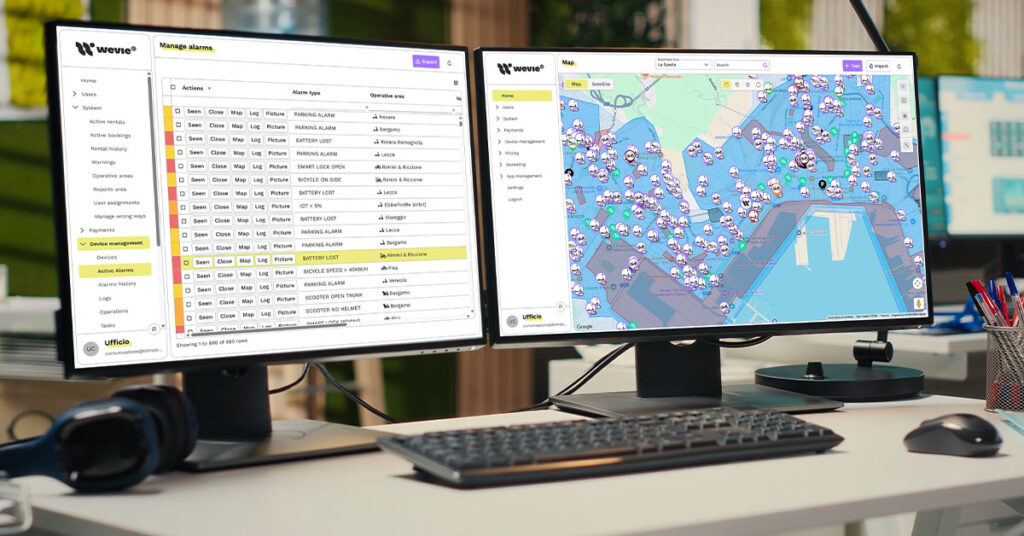
A useful dashboard connects three levels: fleet status, economic performance and operational tasks. This is where data becomes truly valuable.
The risk, otherwise, is having detailed reports that do not lead to action. The team knows what happened, but not what to do next. The difference between monitoring and management is exactly here: seeing the problem is useful, but acting in time is what improves the margin.
Wevie: managing fleet operations with better control
In this context, Wevie can support operators that want to make fleet management more measurable, structured and margin-oriented. The platform combines user app, back office and fleet management tools designed for shared micromobility services.
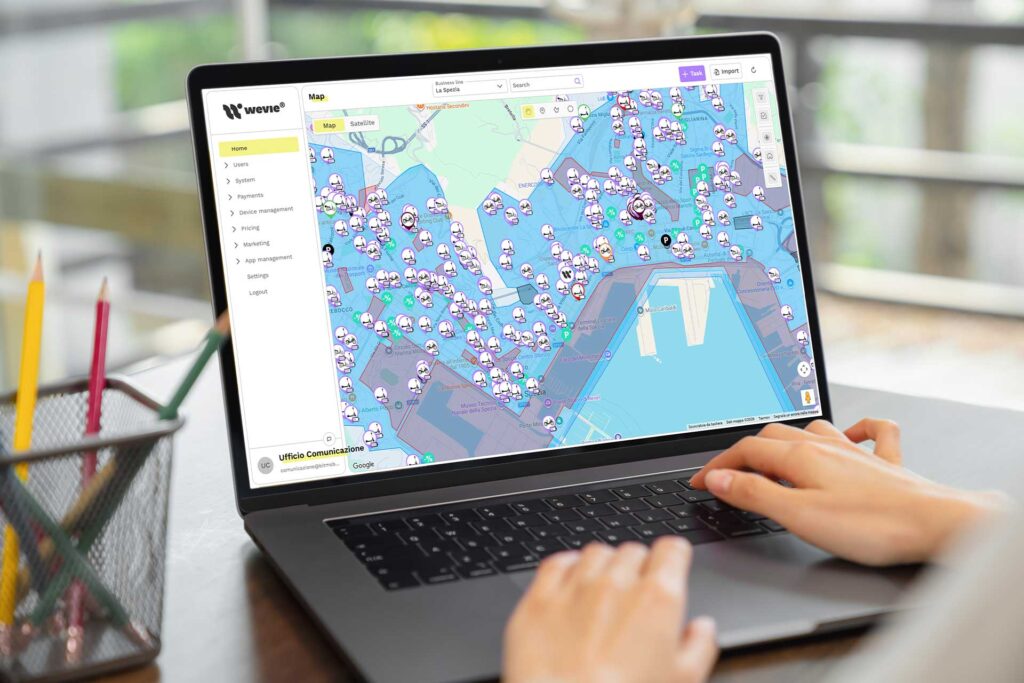
Wevie helps operators monitor vehicles in real time, manage statuses, commands, errors and alerts, work with zones and geofencing, configure pricing models, passes and subscriptions, collect operational data and support field teams with task management. From a profitability perspective, the value is not only in controlling vehicles, but in connecting data, decisions and operations within a single environment.
For rental and sharing companies moving beyond fragmented or semi-manual management, this can help act on several areas at once: idle vehicles, remote diagnostics, flexible pricing, rebalancing suggestions, field tasks and performance analysis. These are all factors that directly affect shared micromobility profitability, especially when the fleet grows or operates across multiple territories.
Discover Wevie features.
How to improve shared micromobility profitability
Improving fleet margins requires method. Operators do not need to change everything at once. It is more useful to start from the areas where value is most often lost and build a continuous optimization process.
The first step is to understand the current situation. How many vehicles are actually available? Which ones generate the most revenue? Which units remain idle too often? Where do technical issues concentrate? Which areas require high operational effort compared with the return they produce?
The second step is to identify the causes. A vehicle may perform poorly because it is in the wrong place, because it has a technical issue, because local demand is weak or because pricing is not aligned with user behavior. Without this distinction, operators risk taking the wrong action.
The third step is to measure the impact of each change. Every intervention should be evaluated based on its effect on margin, not only on the number of rides. A promotion, for example, is not positive simply because it generates more rentals. It is positive if it improves the relationship between revenue, cost and vehicle utilization.
In practical terms, the priorities are simple: increase vehicle utilization, reduce hidden operating costs and help teams make faster decisions.
This approach allows operators to move from experience-based management to evidence-based management. Experience remains important, but it becomes more effective when supported by updated data and the right operational tools.
From vehicle management to margin control
Shared micromobility profitability does not depend only on the number of available vehicles or the volume of rides. It depends on the ability to understand how much each vehicle contributes to margin, how much it costs to keep it operational and how quickly the operator can correct inefficiencies.
A profitable fleet is a governed fleet. Vehicles are better positioned, downtime is reduced, maintenance is more organized, rebalancing is more precise, pricing is more flexible and dashboards help guide daily decisions.
The key shift is to stop seeing the fleet only as a group of vehicles and start reading it as an economic system. Every vehicle is an asset. Every downtime event has a cost. Every relocation should have a reason. Every price configuration should be measured. Every data point should help the team decide what to do next.
For a sharing operator, improving margins means building a model that is more sustainable, measurable and scalable. Growth still matters, but growth without control can quickly become expensive.