Inactive vehicles in shared mobility fleets are one of the most important signals to monitor when managing a micromobility service. An electric scooter, e-bike or other light vehicle may be listed on the platform, visible in the system and formally available, but still generate no rides for hours, days or entire operating time slots.
For a rental operator, this is not only a usage issue. It is an economic issue. Every idle vehicle continues to generate costs: maintenance, insurance, depreciation, charging, recovery, operational checks and space within the fleet.
The goal is not to eliminate every moment of inactivity. In a shared fleet, a certain level of idle time is normal. The real objective is to distinguish between normal inactivity and critical inactivity: the type that reduces margin and prevents the fleet from working at its full potential.
Why inactive vehicles in shared mobility fleets affect margin
Inactive vehicles in shared mobility fleets affect margin because they are assets that absorb resources without generating revenue. A fleet may look large and well distributed, but if part of the vehicles remain unused for too long, overall performance decreases.
The issue becomes even clearer when analyzing performance at vehicle level. Two identical vehicles can produce very different results: one may be rented several times per day, while another remains idle in a low-demand area or with insufficient battery. Their management costs may be similar, but their economic contribution is completely different.
In an article about fleet management, Forbes highlights the importance of monitoring costs, operating conditions, maintenance and vehicle location to manage a fleet efficiently. The same logic applies to shared mobility: without visibility into vehicles and their real usage, it becomes difficult to understand which assets are generating value and which ones are reducing profitability.
Normal inactivity and critical inactivity
Not every idle vehicle is a problem. A vehicle may remain unused for a short period between rides, or during a naturally weaker time slot. This is normal inactivity.
Critical inactivity happens when a vehicle remains idle for too long compared with the fleet average or with the potential of the area where it is located. In this case, the operator needs to take action.
To distinguish between the two situations, operators should look at:
- idle time of each vehicle;
- number of rides per vehicle over a defined period;
- vehicle location in relation to demand areas;
- technical status, battery level, alerts or availability issues;
- performance history by area and time slot.
This analysis helps avoid superficial decisions. It is not enough to see that a vehicle is idle. Operators need to understand why it is idle and how much it affects the overall performance of the fleet. In this sense, inactivity should be read together with revenue per vehicle in shared mobility, because an idle vehicle is not just an unused vehicle. It is an asset that is not contributing to the economic result of the service.
How to identify inactive vehicles in shared mobility fleets
To correctly identify inactive vehicles in shared mobility fleets, operators need to start with a clear definition of inactivity. Without a shared threshold, the risk is to interpret data subjectively.
For example, a vehicle may be considered inactive if it generates no rides for 12, 24 or 48 hours, depending on the city, seasonality and operating model. In a tourist city, one day without rides may already be a signal. In a peripheral area or a minimum-coverage zone, the same data should be interpreted more carefully.
KPIs to monitor
The most useful indicators include:
- last ride completed, to understand how long the vehicle has been idle;
- utilization rate, to measure how much the vehicle is used compared with its availability;
- revenue per vehicle, to assess the economic contribution of each asset;
- average idle time, compared with the fleet average;
- technical or operational alerts, which may explain why the vehicle is not being used.
These data points help build a prioritized list of vehicles to check. Not all vehicles require the same action. Some need to be moved, others require a technical check, while others may be included in a promotion or incentive strategy.
The most common causes of inactivity
Inactive vehicles in shared mobility fleets can depend on different causes. Understanding the cause is essential to choose the right intervention. If the problem is technical, rebalancing is not enough. If the problem is location, maintenance will not solve it. If the problem is pricing, moving the vehicle may have only a limited effect.
Wrong location
The most common cause is location. A vehicle may be perfectly functional, but located in an area with low demand or on a street with poor visibility. In this case, the problem is not the vehicle itself, but its operating context.
When many vehicles remain idle in the same area, the operator should ask whether that zone truly has demand, whether vehicles are visible to users or whether they are being left in low-value points. Often, the most effective action is not to increase the fleet, but to bring vehicles back to where they are more likely to be used.
This is why effective management of idle vehicles also depends on shared micromobility rebalancing, especially when the goal is to reduce operating costs and increase rides without adding more vehicles.
Technical issues or low battery
Another frequent cause is vehicle condition. Low battery, errors, unresolved alerts or minor technical issues can make a vehicle unreliable or unavailable for rental. Sometimes a vehicle appears to be present, but it is not actually ready to generate revenue.
In these cases, inactivity data should be read together with the vehicle’s operational status. If a vehicle is not being rented because of a technical issue, moving it to a better area will not change the result. First, it needs to be made available, safe and usable.
Weak demand or inconsistent pricing
In some cases, vehicles are inactive because demand in the area is weak or because the pricing does not match the context. A zone may have potential in certain time slots and very little demand in others. A poorly aligned rate can reduce usage even further.
Here, the operator’s work is not only logistical. It may be useful to evaluate packages, promotions, incentives or differentiated pricing to stimulate usage at specific times, without reducing margin in areas where demand is already strong.

How to bring inactive vehicles back to revenue
Once inactive vehicles in shared mobility fleets have been identified, the operator needs to decide which action to take. The response should not be automatic. Each vehicle should be assessed based on its location, technical status, usage history and the potential of the area.
The main actions are:
- relocate the vehicle to an area with higher demand;
- check its technical status and resolve any alerts;
- stimulate usage through incentives, promotions or targeted pricing.
These actions can also be combined. A vehicle with low battery in a low-demand area may first require a technical intervention and then relocation. A working vehicle sitting idle in a marginal zone may simply need to be repositioned. A vehicle in a strategic area that is underused during certain time slots may benefit from a dedicated pricing strategy.
Practical example
Imagine a fleet of 500 vehicles. After a weekly analysis, the operator discovers that 40 vehicles have generated no rides in the last 48 hours. Of these, 15 have low battery or technical alerts, 18 are located in low-demand areas and 7 are in strategic areas but are only used during specific time slots.
Treating all of them in the same way would be a mistake. The first group needs maintenance or charging. The second should be repositioned. The third should be monitored through pricing, incentives or availability by time slot.
This example shows why inactive vehicles in shared mobility fleets are not only a problem to be corrected, but also a source of information about how the fleet actually works.
The role of Wevie in managing inactive vehicles
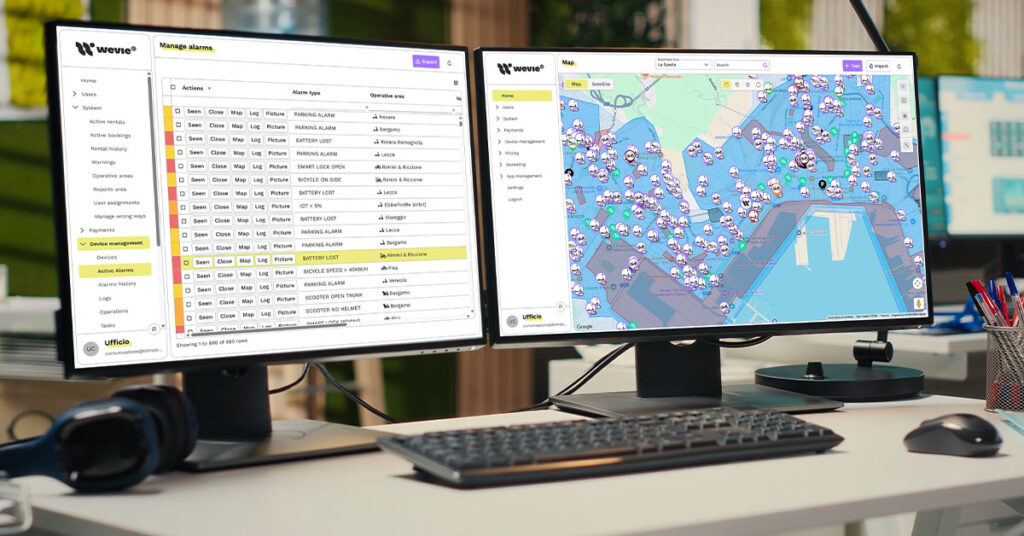
To reduce the impact of inactive vehicles in shared mobility fleets, operators need a platform that connects data, location, vehicle status and operational actions. Wevie can help rental operators monitor the fleet in real time, read statuses, errors and alerts, manage zones and geofencing, organize tasks for operators and use rebalancing suggestions to bring vehicles back to areas where they can generate more value.
The advantage is operational before it is technological. A platform like Wevie helps operators understand which vehicles are idle, why they are idle and which action makes the most sense: maintenance, relocation, technical check or pricing strategy. For an operator, this means reducing manual decisions, avoiding unnecessary work and turning unproductive vehicles into assets that are closer to real demand.
To evaluate how these logics could be applied to your service, you can request a Wevie demo and explore how the platform supports day-to-day fleet operations.
From idle vehicles to operational value
Inactive vehicles in shared mobility fleets should be read as a strategic indicator, not just as a logistics problem. Every idle vehicle can reveal something: an ineffective area, a distribution issue, delayed maintenance, unsuitable pricing or weaker-than-expected demand.
If many vehicles remain idle, the problem may depend on distribution, maintenance, pricing, local demand or limited operational visibility.
For a more complete view of these levers, this topic can be part of the broader framework dedicated to shared micromobility profitability and fleet operating margins, where revenue, costs, utilization rate and operational management are analyzed together.
The decisive step is to turn inactivity from a passive data point into an operational lever. When inactive vehicles in shared mobility fleets are monitored methodically, they are no longer just vehicles to recover. They become useful signals for improving distribution, maintenance, utilization and service profitability.