Businesses that invest in sustainable corporate mobility are choosing a path that combines responsibility and competitiveness. Sustainability is no longer just an ethical issue: reducing the environmental impact of your fleet means lowering operating costs, accessing incentives and improving brand perception. In a context where regulations are becoming increasingly stringent and customers demand transparency, adopting green mobility strategies is a long-term investment.
To understand how scooter fleet management software can support these strategies and integrate with other solutions, read our article Scooter Fleet Management Software.
Why switch to sustainable corporate mobility
Moving to an electric or hybrid fleet brings immediate economic benefits. Electric vehicles have lower maintenance costs than combustion-engine vehicles: fewer parts subject to wear, no oil changes and brakes that last longer. The electricity used for charging costs less than fossil fuel, especially when companies install in-house charging stations and sign contracts with green energy providers. In addition to direct savings, there are grants for the purchase or long-term rental of low-emission vehicles, tax deductions, vehicle tax exemptions and incentives for charging infrastructure. Many cities offer free or discounted access to limited-traffic zones for electric vehicles, allowing businesses to save on permits and reach customers and suppliers more easily.
According to the International Energy Agency in its Global EV Outlook report, the rapid growth of electric vehicles and shared mobility solutions is helping reduce emissions and operating costs in urban transport, making investment in sustainable corporate fleets increasingly advantageous.
From a reputational perspective, adopting a sustainable corporate mobility policy shows a company’s commitment to the environment and society. Customers and employees are increasingly sensitive to these issues: a business that reduces the number of cars and encourages cleaner, shared solutions is perceived as innovative and responsible. This can translate into a competitive market advantage and greater appeal to talent.
Electrification strategies and vehicle selection
To define a sustainable corporate mobility strategy, companies need to analyze their operational requirements. Electric cars are ideal for urban travel and routes under 200 km, while plug-in hybrid vehicles are perfect for those who need greater range. Businesses that make deliveries in cities can use electric vans to reduce fuel costs and comply with restrictions on access to historic centers. For short employee trips, e-bikes and scooters offer a fast and environmentally friendly alternative.
Also read: Urban micromobility: benefits and opportunities for the cities of the future.
One often overlooked aspect is the choice of acquisition model. Long-term rental of electric vehicles is an increasingly common solution: it includes maintenance, insurance and roadside assistance. This way, the company avoids the initial capital investment and can update its fleet with more efficient models at the end of the contract. This formula makes it possible to test whether the vehicles match business needs before deciding on a purchase.
Car pooling and corporate sharing
Reducing the number of vehicles on the road is one of the main goals of sustainable corporate mobility. Internal car pooling allows employees to share a car to commute to work or travel for common business trips, thus reducing traffic and emissions. Implementing a car pooling system requires booking software and centralized coordination; in some companies, apps are used to suggest travel matches and calculate the CO2 saved.
In addition to car pooling, many businesses are introducing internal car sharing services, where employees can book a company vehicle for work trips. This approach reduces the need for mileage reimbursements, simplifies travel management and makes it possible to monitor real costs. Sharing services can also be extended to light vehicles: for example, scooters or e-bikes can be used for short trips within corporate campuses.

The transition to sustainable corporate mobility requires investment in infrastructure. Companies need to install charging stations for electric vehicles, preferably powered by renewable energy. Some businesses choose smart charging systems that optimize electricity consumption based on time-of-use tariffs, reducing costs. At the same time, it is essential to use a software platform that manages every aspect of the fleet: booking, monitoring, maintenance and reporting.
Managing corporate mobility in a smart way
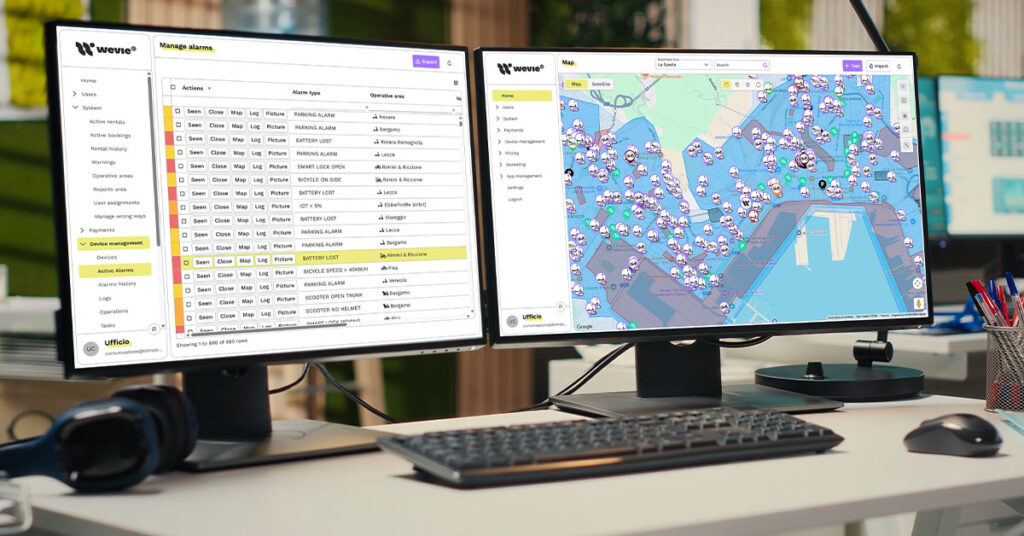
To coordinate the different elements of sustainable corporate mobility, businesses need robust digital platforms. Our platform is an all-in-one solution that makes it possible to monitor vehicle location in real time, analyze routes and manage vehicle assignment. It allows companies to set different roles and privileges for employees, limiting access to those who genuinely need to use the vehicles. Reporting features provide a complete overview of costs, CO2 saved and vehicle usage, supporting strategic decision-making.
The platform also integrates car sharing modules that help reduce the total number of vehicles in the fleet and optimize their use. It supports different types of vehicles, from electric cars to scooters. Thanks to standard APIs and integrations with payment systems and business software, it can adapt to both multinational organizations and small businesses.
If you are interested in testing how Wevie can improve the management of your corporate fleet, contact us to book a demo.
Planning and measuring results
To implement a sustainable corporate mobility program successfully, it is essential to define clear and measurable goals. These may include reducing the fleet by 30% over three years, cutting emissions by 50% or increasing the vehicle utilization rate. Using monitoring tools, the company can track progress and make adjustments. For example, if analysis shows that cars remain unused, the number of vehicles can be reduced. If employees struggle to adopt e-bikes, the company can provide training or encourage usage through incentives.
An investment in the future
Adopting sustainable corporate mobility means investing in the future of the business and the planet. The economic benefits, tax advantages and positive reputation more than offset the initial commitment. Thanks to the combination of electric vehicles, car pooling solutions and advanced digital platforms, companies can reduce costs and contribute to the ecological transition.
Also read: Electric fleet management software: how to choose the right solution.